A Spouting Fish With A Horizontal Tail
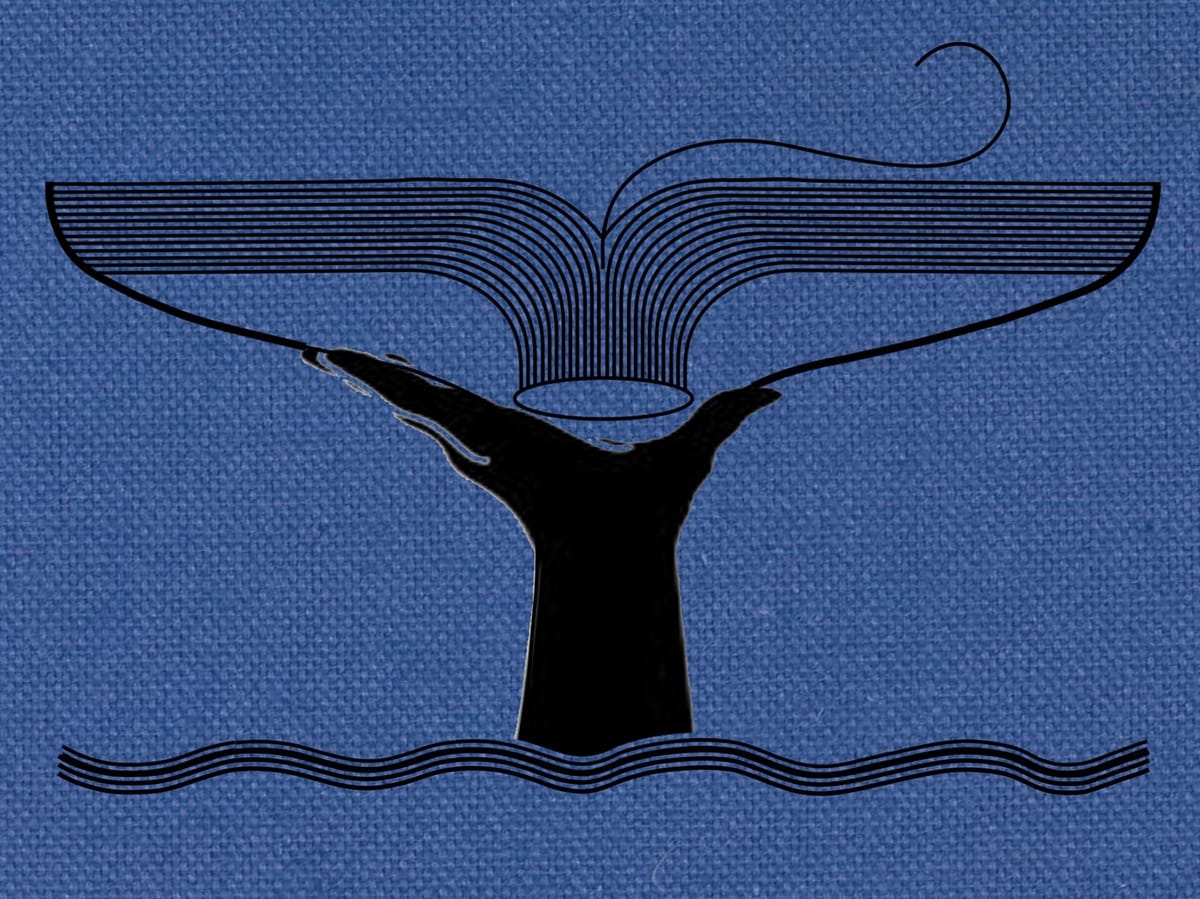
Pick up a hardbound book and open it flat. Look at it from below.
What you are holding is a whale's tail.
The two covers spread outward from the spine like flukes from a root. The pages taper toward the fore-edge at either end. The central margin where the pages meet forms the crotch, that narrow vacancy between the two broad palms. Melville describes this profile in Chapter 86 of Moby-Dick with a precision that has nothing to do with zoology:
"The compact round body of its root expands into two broad, firm, flat palms or flukes, gradually shoaling away to less than an inch in thickness. At the crotch or junction, these flukes slightly overlap, then sideways recede from each other like wings, leaving a wide vacancy between."
This is not a description of a whale's tail. It is a description of an open book held from below, rendered in the vocabulary of whaling. The two objects are so physically similar that Melville could write one sentence and mean both simultaneously — which is precisely what he did.
This is the engine of Moby-Dick. Whale and book share not merely a passing resemblance but an entire anatomical vocabulary. Head, tail, spine, case — the primary terms of bookbinding jargon translate one-to-one into the anatomy of a sperm whale, and Melville knew it. He built his novel on that foundation, chapter by chapter, across 200,000 words, encoding a complete self-portrait of his own act of composition inside a whaling narrative so vivid and life-like that nobody looked beneath it for 174 years.
The first hint that this is intentional rather than coincidental appears before Moby-Dick was published. In March 1850, Melville contributed a short review to a literary magazine called Literary World. Its title was "A Thought on Book-Binding." On its face, the piece reviews a new edition of James Fenimore Cooper's The Red Rover — but its true subject is announced in its title. The review is a meditation on bookbinding, and it functions as Melville's most candid pre-publication statement of method.
He calls the technique a "clever device" involving "cyphers" and what he terms "poetical signification and pictorial shadowing forth." He invokes Francis Bacon — the father of empirical method — to signal that what follows in The Whale will not be mere allegory or vague symbolism but something measurable, systematic, and verifiable. And he names the horseshoe nailed to the mast as an example of such "pictorial shadowing" — the same horseshoe that appears opposite Ahab's doubloon in Chapter 99 of the novel, linking the review directly to the book's symbolic architecture.
The review tells you, a year before publication, that Moby-Dick will conceal a system of ciphers whose solutions produce "pictorial shadowings" of real objects. What it does not tell you is that the primary object being shadowed is the book itself — the physical artifact you are holding in your hands.
Melville defines the whale, in Chapter 32, as "a spouting fish with a horizontal tail." Scholars have puzzled over this definition for generations. It is, on its face, wrong — whales are mammals, not fish. Melville knows this. He says explicitly that his definition is "the result of expanded meditation," meaning it excludes features that don't serve his design. Warm-bloodedness doesn't serve the design. A published book is cold. But the horizontal tail does serve it — because the horizontal tail, seen in profile, is the open book.
The whale's definition is a bookbinder's definition. The "spouting fish" is a text whose contents exhale from page to reader. The "horizontal tail" is the spread of an opened book seen from below. Melville narrows the whale to these two features because they are the two features that shadow the book most precisely. Everything else is trimmed away.
And the shared vocabulary runs deeper still. In bookbinding, the tail is the lower edge of the bound book block. The headis the upper edge. The spine is the bound edge. The case is the outer covering — boards and cloth — that encases the pages. Every one of these terms translates directly and without alteration into the anatomy of a sperm whale. Melville did not invent this correspondence. He found it and built a novel around it.
Now return to the tail — and this time, hold the book while you read.
Chapter 86 describes five motions of the whale's tail. Each one, performed with a bound book rather than imagined at sea, resolves into a precise physical action any reader can replicate. Melville says as much: "the more I consider this mighty tail, the more do I deplore my inability to express it. At times there are gestures in it, which, though they would well grace the hand of man, remain wholly inexplicable."
The gestures remain inexplicable from the whale-end of the conceit. From the book-end they are self-evident.
The first motion: "when used as a fin for progression." The tail is the sole means of propulsion. "Scroll-wise coiled forwards beneath the body, and then rapidly sprung backwards." A reader moves a page from one side to the other to progress through the book — bending a bulk of pages scroll-wise beneath the body before letting them spring backwards. The tail is how the book moves forward. It is the means of progression.
The second motion: "when used as a mace in battle." The whale curves its flukes away and strikes by recoil. A turned page, landing, gives exactly this blow — the displaced air, the gentle concussive effect of a page settling. Exaggerated to the scale of the surface narrative, it becomes a weapon. At the scale of a reader's hand, it is child's play. Melville says so: "these submerged side blows are so often received in the fishery, that they are accounted mere child's play."
The third motion: "the delicate business of sweeping." The whale sweeps its tail with extraordinary delicacy across the surface. A reader finding a page with a fingertip — that precise, searching sweep along the fore-edge — performs the same gesture.
The fourth motion: "lobtailing." The whale raises its flukes high and brings them down with thunderous force, the "thunderous concussion" displacing vast quantities of water. Closing a book — bringing both halves firmly together, the clap of displaced air — is lobtailing. The concussion is the book snapping shut.
The fifth motion: "peaking flukes." The whale stands with flukes erect out of the water, then they fall into two masses on either side. A book taken from a shelf: tail tossed erect into the air, pages standing upright for a moment before settling into two equal masses. The open book, seen from below, is a whale with its flukes peaked.
"When I consider this mighty tail," Melville writes, "the more do I deplore my inability to express it."
He is not deploring his inability to describe a whale. He is deploring his inability to say outright — in the surface narrative, in the whale-tongue, the only language available to him — what the tail actually is. He can encode it. He can shadow it. He can give you five precise gestures that resolve perfectly if you are holding a book in your hand. But he cannot say: the tail is the book. That would collapse the conceit. That would flatten the stereotext to a single layer and destroy the mechanism that generates everything else.
So he calls it inexplicable. And leaves you with the gestures.
Pick up a book. Perform them. The whale will surface.