The Whale's Eyes
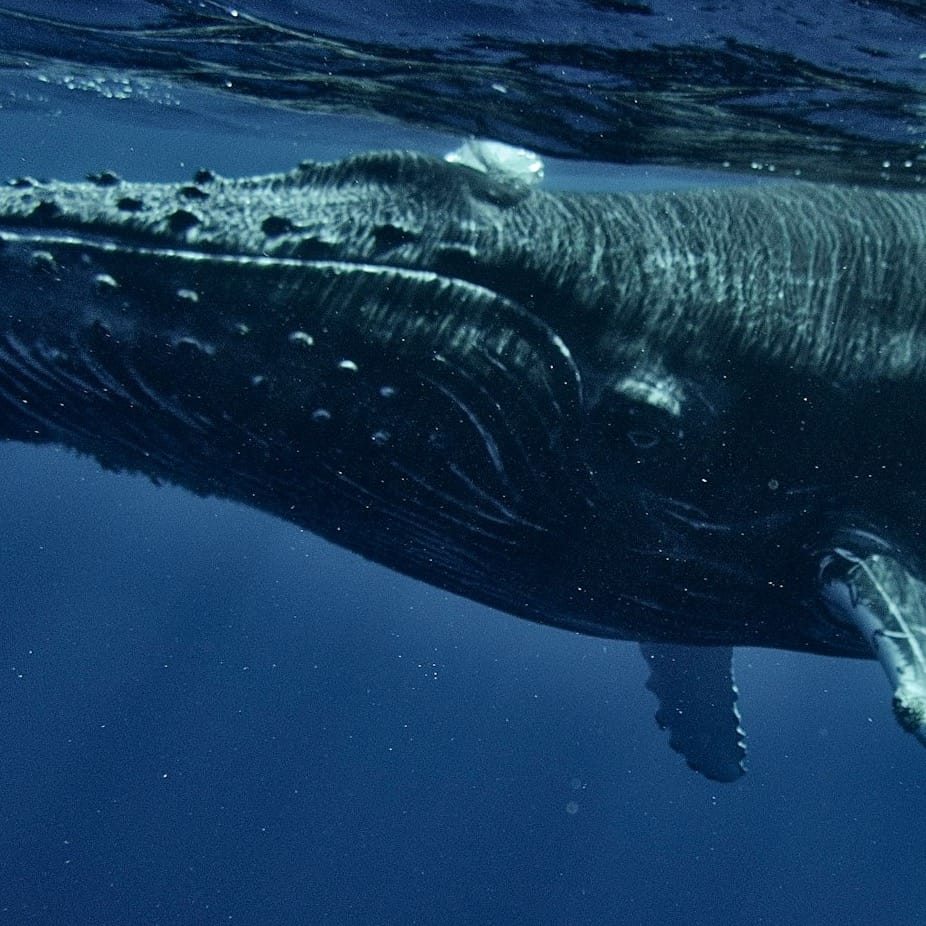
Moby-Dick is a book about two things at once. That isn't a metaphor. It's an engineering specification — and Melville tells you so directly, in Chapter 74, using a sperm whale's eyes.
A sperm whale cannot see straight ahead. Its eyes sit on opposite sides of its head, giving it two completely separate fields of vision — one facing left, one facing right, each seeing a different world entirely. Melville pauses the narrative to ask a question he calls "a most curious and most puzzling":
"...both his eyes, in themselves, must simultaneously act; but is his brain so much more comprehensive, combining, and subtle than man's, that he can at the same moment of time attentively examine two distinct prospects, one on one side of him, and the other in an exactly opposite direction? If he can, then is it as marvellous a thing in him, as if a man were able simultaneously to go through the demonstrations of two distinct problems in Euclid."
He says he must be "content with a hint." The hint is the novel itself.
Because Moby-Dick is designed to do exactly what Melville describes. It sustains two complete, internally consistent readings simultaneously — one on each side of the page, pointing in exactly opposite directions. The surface narrative: a whaling voyage, an obsessive captain, a white whale. And encoded beneath it, running through every chapter across 200,000 words: a real-time self-portrait of Melville composing the very words you are reading, verifiable against his original manuscripts.
The term for a text engineered this way is stereotext — from stereoscopic vision, where two flat images, each complete in itself, combine to produce a dimension present in neither alone. The depth only exists when both images are held active simultaneously. Collapse to one and the effect vanishes. The same is true here. Read only the whaling narrative and you have one of the great novels in any language. Read only the encoded layer and you have a portrait of a man at his desk, writing. Hold both at once and something else entirely appears — a third thing, generated by their interaction, that neither layer contains on its own.
Melville was content with a hint. He left it in the whale's eyes, 174 years ago, for someone to find.